Computational Mechanics2026Open access

An Overlapping Schwarz Space-Time Refinement Framework for Multi-Resolution Material Point Method

Zhaofeng Luo1 Minchen Li1,2,* Yupeng Jiang3,*

1Carnegie Mellon University 2Genesis AI 3IBNM, Leibniz Universität Hannover *Corresponding authors

Refine a material point simulation only where, and when, it is needed. OS-MPM couples a coarse background domain and a fine local domain, each with its own grid, particles and time step, through an overlapping Schwarz iteration. Inside each subdomain the solver is standard MPM.

Subdomains
Displacement
Coarse-domain particles and grid, hB = 1/60 m Fine-domain particles and grid, hS = 1/120 m Displacement magnitude, 00.55 m 3D folding example of the paper: two stiff panels on a hinge a hundred times softer, folded through 90°. Both views show the same run. The displacement is measured from the initial flat state and interpolated from the particles to the surface of the body, using the fine particles where the fine domain is solved and the coarse particles elsewhere.
4.3–9.1×
faster than uniform fine-grid MPM at the finest tested resolution of the elastic-inclusion benchmark, at comparable stress error
2–4
Schwarz iterations per coarse step on average, across contact, inclusion and 3D folding runs
≤ 0.5%
difference from a single-domain solution along the whole large-deflection cantilever master curve
01 · Idea

Fine resolution where the mechanics is, coarse everywhere else

Accurate stresses near a contact patch, a material interface or a hinge need a fine grid and a small time step. Refining uniformly pays that price over the whole body.

OS-MPM lets a coarse domain ΩB and a fine domain ΩS overlap. Each is advanced by ordinary implicit MPM, using the other’s velocity as a boundary condition on the overlap, and the two solves are repeated until the interface velocities agree. The fine domain can take several small time steps per coarse step.

No modified kernels, Lagrange multipliers or penalty parameters are needed.

Uniform refinement

Fine cells and small time steps over the whole body.

OS-MPM

A fine patch with its own grid and time step, overlapping a coarse background.

Coarse domain ΩB Fine domain ΩS Overlap
02 · Method

One coarse time step of OS-MPM

The coarse domain uses grid spacing \(\Delta x_B\) and time step \(\Delta T\); the fine domain uses \(\Delta x_S \le \Delta x_B\) and \(\Delta t = \Delta T / M\). Each has its own particles, coupled only through grid boundary conditions on the overlap.

Alternating Schwarz, step by step
From \(t_n\) to \(t_{n+1}\)
Schwarz sweep k = 1
ΩB coarse grid ΔxB, step ΔT ΩS fine grid ΔxS, step Δt = ΔT / M overlap ΓS receives from coarse ΓB receives from fine Time ΩB ΔT ΩS Δt Δt Δt tn tn+1 Interface residual tolerance ε k = 1 k = 2
Swipe sideways to see the whole diagram.
Schematic with \(M = 3\) sub-steps and two sweeps. In the paper’s runs the Schwarz loop needs about two to four sweeps per coarse step.
Space · fine → coarse

Projection, not point sampling

Fine-grid velocities reach a coarse boundary node as a mass-weighted average over its whole support, in the same way particles are transferred to a grid.

Time · coarse → fine

Interpolated boundary data

Coarse boundary velocities at \(t_n\) and \(t_{n+1}\) are interpolated linearly to each of the \(M\) fine sub-steps.

Coupling nodes

Found from the particles

The receiving grid nodes are selected each frame from the footprint of pre-marked boundary particles, so no interface geometry is tracked.

03 · Results

Checked against analytical and single-domain solutions

CPU time at the finest resolution, \(h = 0.004\) m
Elastic inclusion benchmark, total time to equilibrium in seconds.
Uniform fine-grid MPM OS-MPM

Several times faster at comparable accuracy

A circular inclusion with a misfit strain sits in an elastic matrix, and only its vicinity is refined. At the finest tested resolution both solvers reach comparable stress errors, and OS-MPM is 6.6, 9.1 and 4.3 times faster for stiffness ratios 1, 2 and 5.

The saving grows with resolution. One level coarser the ratios are 2.0, 1.9 and 0.9, and on the two coarsest grids OS-MPM is slower than the uniform solver.

Timings include all Schwarz iterations and interface transfers.
Stress fields match the single-domain solution

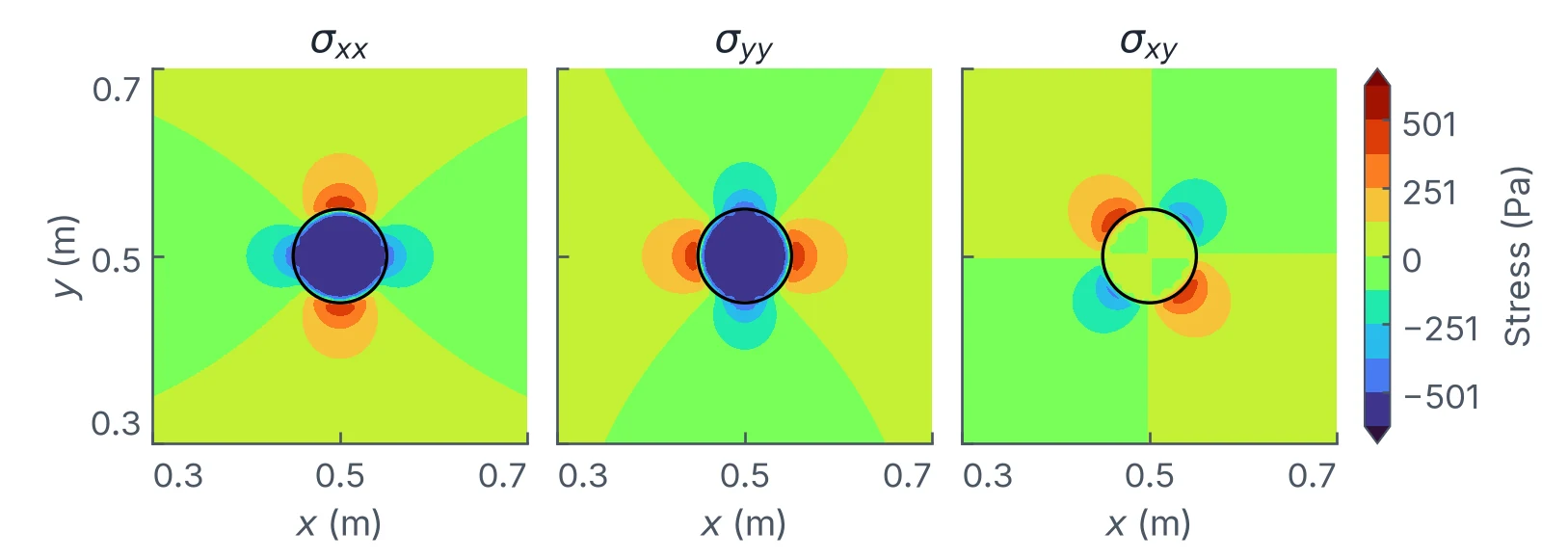
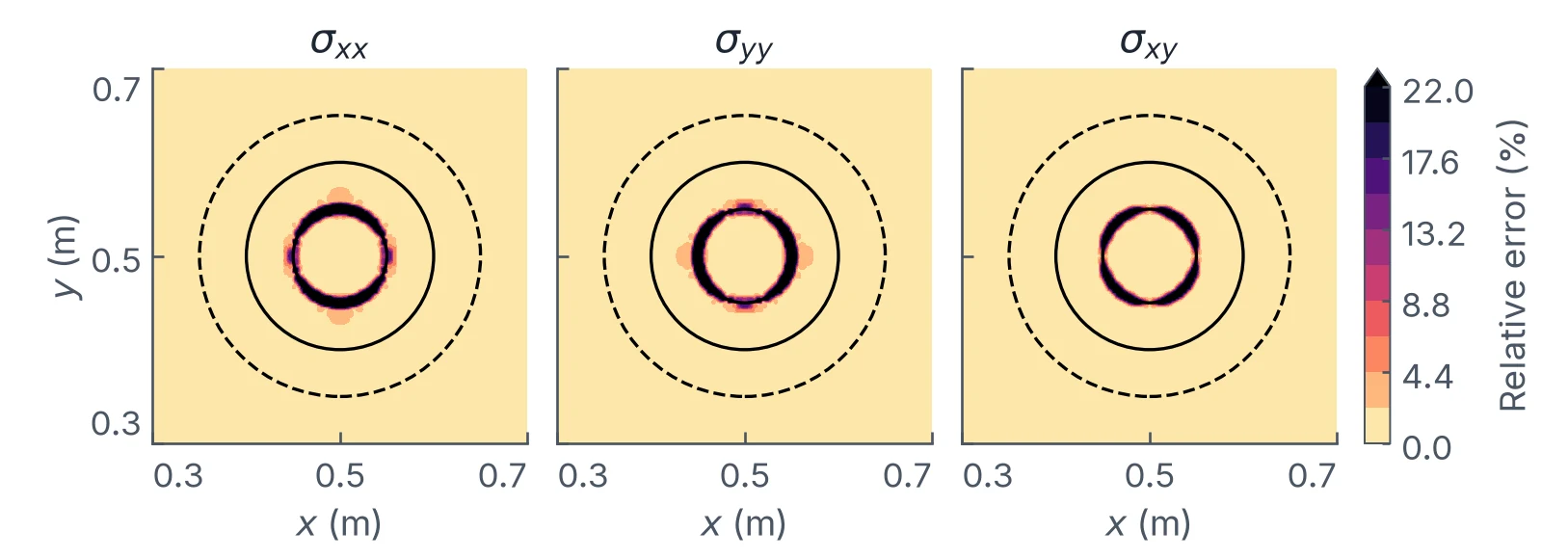
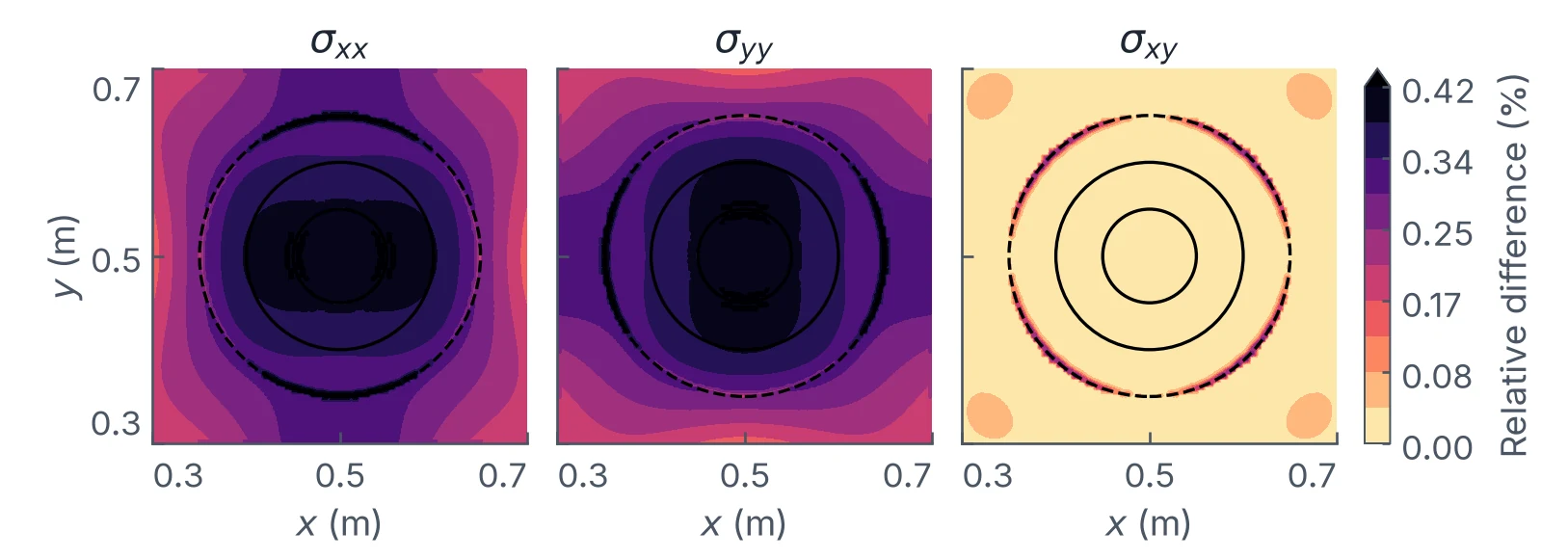
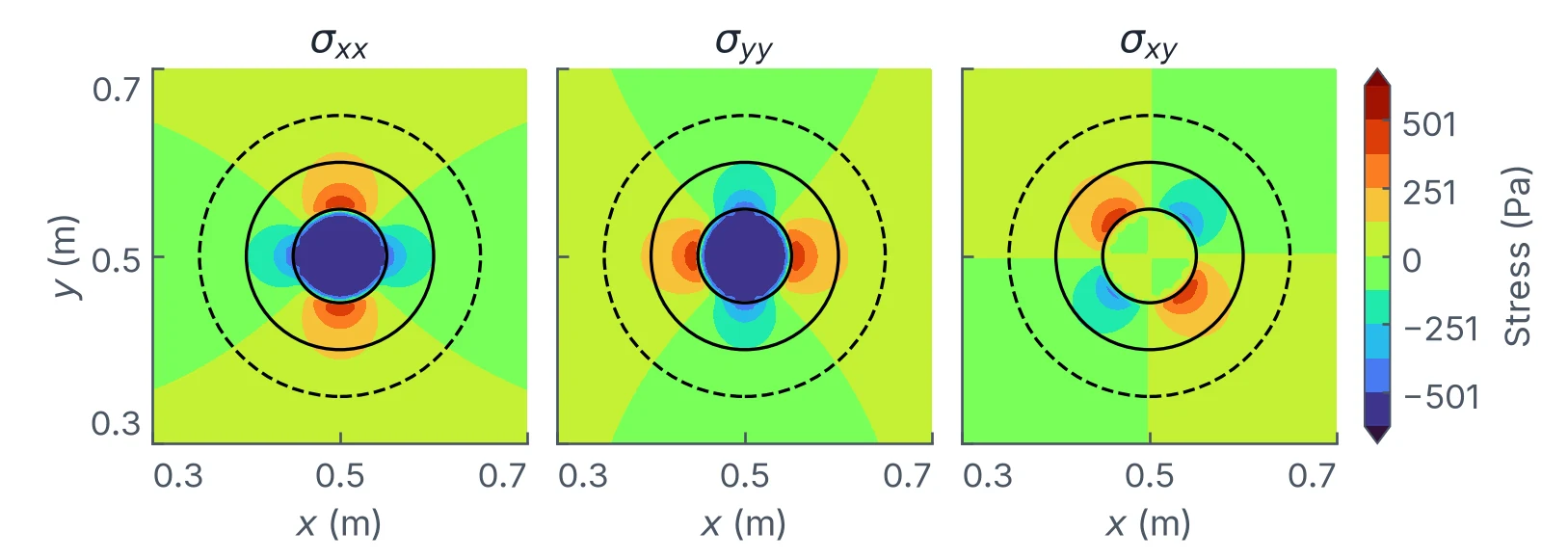
In the same benchmark, the two solvers give the same stress fields at the plotted scale. At 99% of the plotted points, OS-MPM differs from single-domain MPM by less than 1.5% of the peak stress, for all three stiffness ratios. The error against the analytical solution is more than ten times larger. It sits in a narrow band on the inclusion boundary and is common to both solvers: it comes from a sharp material interface on a regular grid, not from the coupling.

Stiffness ratio \(E_{\mathrm{in}}/E_{\mathrm{out}}\)

OS-MPM

OS-MPM stress fields of the elastic inclusion: the three in-plane stress components, with the inclusion, the coarse-domain hole and the fine-domain boundary drawn as circles.

Single-domain MPM

Single-domain MPM stress fields of the same problem, on the same colour scale. They look the same as the OS-MPM fields.

OS-MPM against the analytical solution

Relative error of OS-MPM against the analytical solution for the three stress components. The error is confined to a thin ring on the inclusion boundary.

OS-MPM against single-domain MPM

Relative difference between OS-MPM and single-domain MPM for the three stress components, on a colour scale far smaller than that of the analytical error.
Stress fields at \(h = 0.004\) m. Errors and differences are percentages of the largest analytical value of each component, and their colour scales end at the 99th percentile. Solid circles: inclusion and coarse-domain hole. Dashed circle: fine-domain boundary. Fig. 12, rearranged

Contact and large-deflection bending

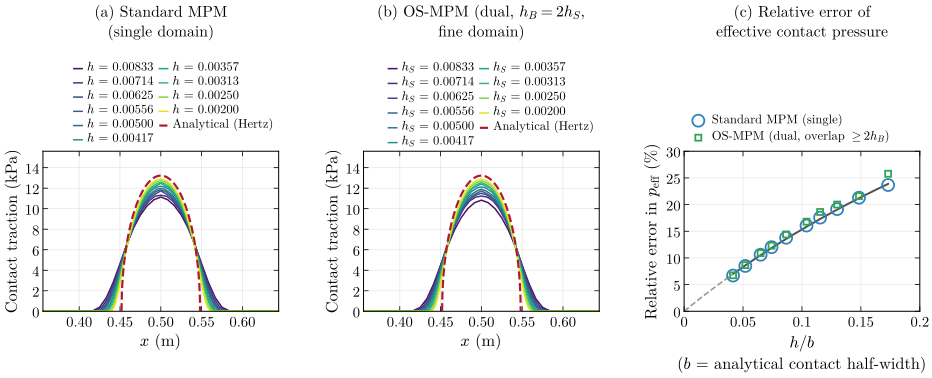
Contact pressure profiles for uniform-grid MPM and for OS-MPM at ten resolutions against the analytical Hertz profile, and the relative error of the effective peak pressure against grid spacing.
Hertzian contact. Pressure profiles of (a) uniform-grid MPM and (b) OS-MPM agree at matching grid spacing, and (c) both approach the analytical solution along the same line. Fig. 10
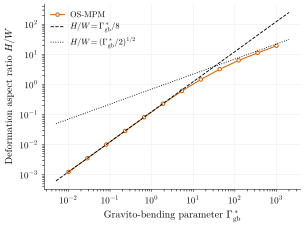
Log-log plot of deformation aspect ratio against the gravito-bending parameter. The OS-MPM points follow the small-deflection line and bend toward the large-deflection line.
Gravity-driven cantilever. Within 0.5% of single-domain MPM at twelve load levels. Fig. 7

Large strain

A notched Neo-Hookean bar, refined around the notches, is stretched to 149% grip strain. The Schwarz loop needs two to three iterations per coarse step throughout.

APIC run of the paper, every saved state drawn with all particles, up to 147.7% grip strain. The run ends at 149.4%, when the neck separates numerically.

Scope. The subdomains are prescribed on the particles before the run, all examples are elastic, and speed-ups are measured against uniform refinement. The paper discusses these limits and the extensions left to future work.

04 · Citation

Cite this work

Luo, Z., Li, M. & Jiang, Y. An overlapping Schwarz space-time refinement framework for multi-resolution material point method. Computational Mechanics (2026). https://doi.org/10.1007/s00466-026-02884-6

@article{luo2026osmpm,
  title     = {An overlapping {S}chwarz space-time refinement framework for multi-resolution material point method},
  author    = {Luo, Zhaofeng and Li, Minchen and Jiang, Yupeng},
  journal   = {Computational Mechanics},
  year      = {2026},
  publisher = {Springer},
  doi       = {10.1007/s00466-026-02884-6},
  url       = {https://doi.org/10.1007/s00466-026-02884-6}
}

Acknowledgments. We sincerely thank Qirui Fu for valuable discussion. Yupeng Jiang acknowledges the financial support from the International Research Training Group (IRTG) 2657, funded by the German Research Foundation (DFG) (Project-ID 433082294). Minchen Li acknowledges Carnegie Mellon University for the Junior Faculty Startup Fund and Genesis AI for the gift funding.